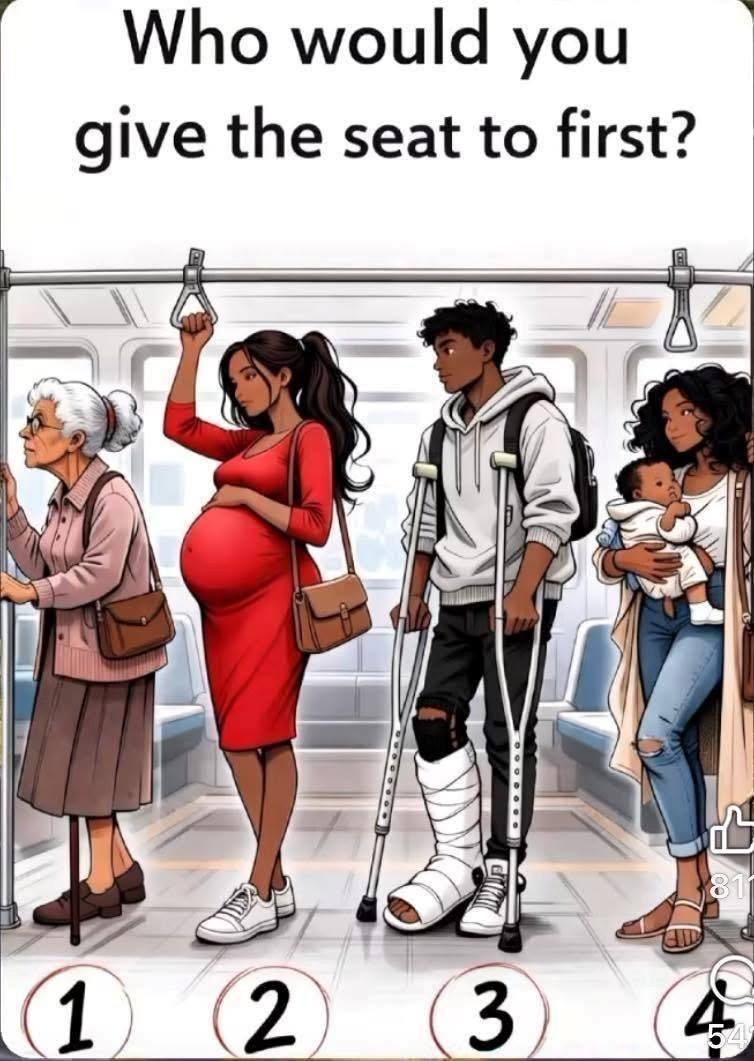
Who Would You Give the Seat to First? A Thoughtful Reflection on Courtesy, Empathy, and Social Values

ADVERTISEMENT

Psychologists call this intuitive moral decision-making. It is efficient but not always perfect.

For example, someone may automatically offer a seat to an elderly person without noticing that another person nearby is visibly struggling more. Or they may hesitate due to uncertainty, leading to inaction.

This shows that morality in everyday life is not just about principles—it is also about perception speed and emotional readiness.

Power, Privilege, and the Seat We Take for Granted
A seat is also a symbol of privilege. Being seated means comfort and stability, while standing often means effort and vulnerability.

In public spaces, those who sit often hold a small but real advantage over those who stand. This creates an unspoken hierarchy of comfort.

When we choose who gets the seat first, we are briefly distributing privilege. That makes the act more meaningful than it appears.

It also raises uncomfortable questions:

Do we notice who is always standing?
Do we assume certain people are “fine” because they look capable?
Do we overlook quiet suffering because it is not visible?
In this sense, giving a seat is not just kindness—it is awareness of inequality in real time.

The Pressure of Being Watched
One often overlooked factor in these situations is social observation. People behave differently when they feel watched.

In public transport or crowded spaces, offering a seat can be influenced by:

Fear of being judged as rude
Desire to be seen as polite
Pressure from cultural expectations
Awareness of group norms
This means that sometimes, the act is not purely moral but socially reinforced.

However, even if motivation is mixed, the outcome can still be positive. A seat is still offered. A person still benefits.Continue reading…

Leave a Comment