ADVERTISEMENT
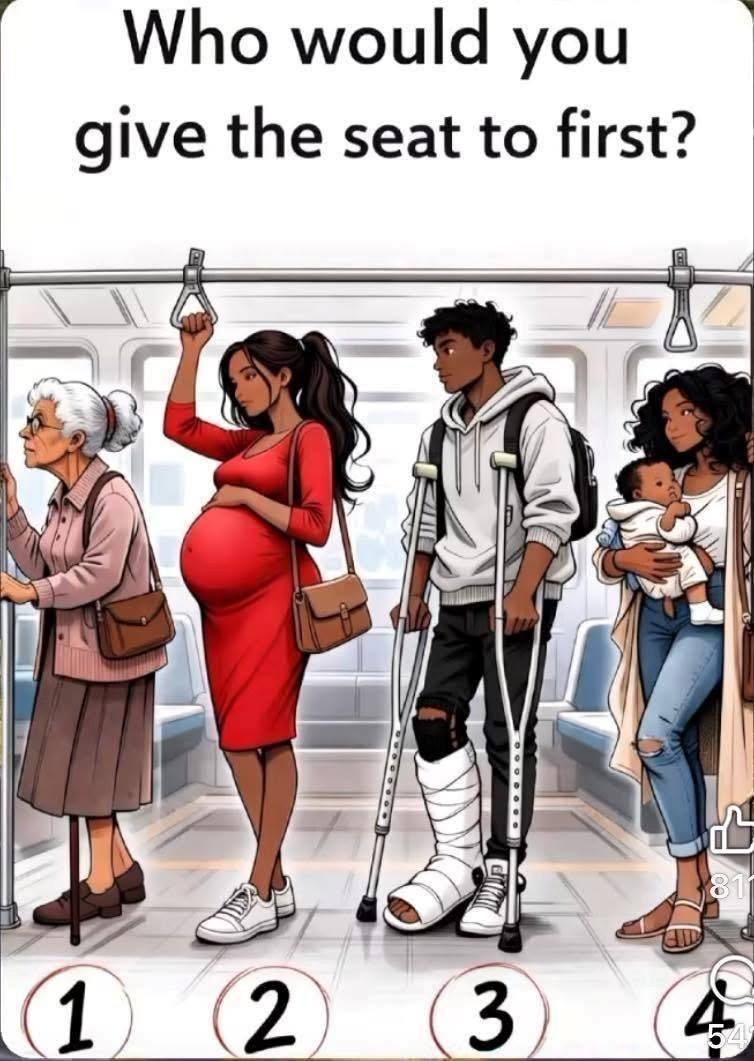
This raises an interesting moral question: Does intention matter more than action? Or does helping someone matter regardless of motivation?
Silence in such situations can come from:
Uncertainty about who should act
Fear of embarrassment if mistaken
Assumption that someone else will step in
Emotional fatigue or distraction
Normalization of inaction
This phenomenon is known in social psychology as diffusion of responsibility. When many people are present, individuals may feel less personally responsible to act.
This shows that moral action often requires not just awareness, but initiative.
The Quiet Courage of Choosing
Deciding who to give the seat to first may seem simple, but it requires subtle courage.
Observing carefully rather than assuming
Acting despite uncertainty
Accepting that not everyone will agree
Prioritizing kindness over hesitation
Sometimes, it also involves apologizing if the choice feels imperfect. Because in real life, decisions are rarely flawless.
Expanding the Question Beyond Physical Seats
While the question begins with a literal seat, it extends far beyond that.
Who gets our time first
Who gets attention in a conversation
Who receives opportunities
Who is listened to in group settings
Whose needs are prioritized in shared spaces
In this sense, “giving a seat” becomes a metaphor for social priority.
It asks us:
Empathy in Modern Life
In fast-paced environments, empathy can be difficult to maintain. People are often distracted, rushed, or mentally overloaded.
As a result, small acts like offering a seat become even more meaningful. They interrupt autopilot behavior and reintroduce awareness of others.
