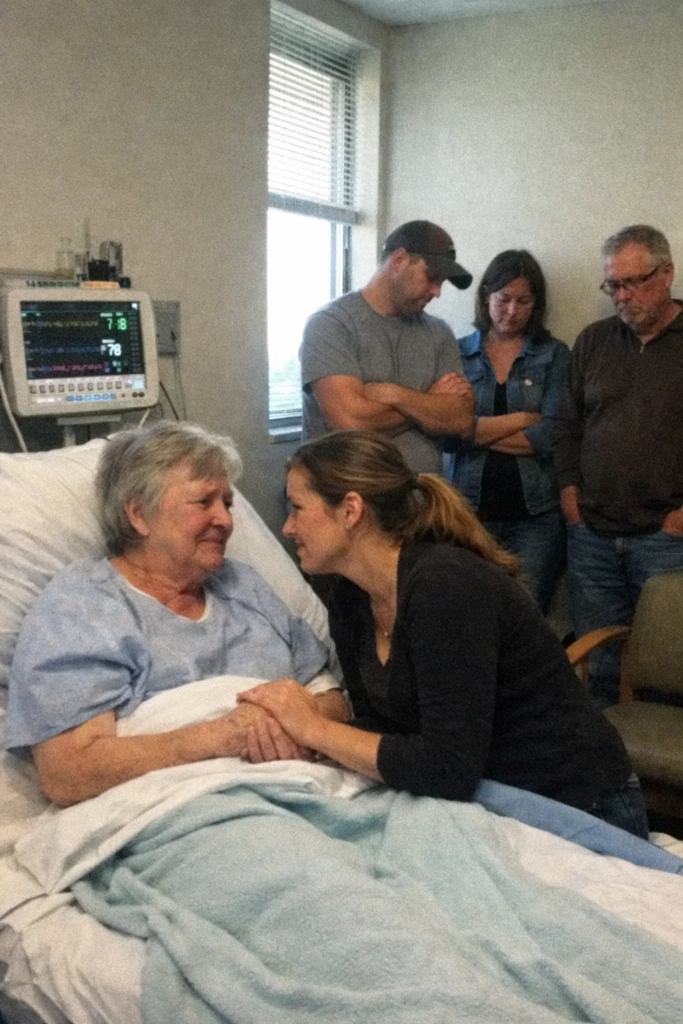
All eight of them had gathered after the hospital called two days earlier, filling the room with coats, worried expressions, and the uneasy energy of people who knew a difficult conversation was approaching.
At first Rose kept smiling.
It was the hopeful kind of smile mothers sometimes wear when they believe the family they built will rise to meet the moment.
Her eyes moved slowly from child to child, the way someone might scan a familiar room, expecting comfort from every corner.
Eight children.
Eight lives she had raised with tired hands and stubborn determination.
Eight names she had whispered into the dark when bills piled up and sleep refused to come.
For a moment she looked proud, almost relieved that they were all there together.
Then the first excuse arrived.
Her oldest son, Richard Bennett, cleared his throat and shifted his weight like a man trying to find solid ground.
“Mom, you know I would help if I could,” he began carefully, “but the mortgage just went up again and we’re barely holding the house as it is.”
The second voice came quickly after.
Her daughter Cynthia glanced at the screen of her phone.
“I’m supposed to leave for Arizona on Friday,” she said. “This trip’s been planned for months. The tickets are nonrefundable.”
Another brother leaned against the wall with a sigh that sounded more irritated than concerned.
“My company’s cutting staff right now,” Marcus said. “If I disappear for weeks, I’m the first one out the door.”
One sister explained that her husband would never agree to such an arrangement.
Another insisted their house was too small.
One brother said his back couldn’t handle lifting someone who needed assistance.
Another offered to “help with paperwork.”
Another promised he would “visit often.”
The words stacked together until the room felt crowded with reasons.
Each explanation sounded reasonable on its own.

Together they formed something colder.
Through all of it, Rose kept smiling.
But the smile changed slowly.
It lost the confidence it held at the beginning.
Then it lost the warmth.
Finally it faded into something fragile that trembled around the edges.
Standing near the foot of the bed was the youngest child, Anna Bennett.
She had always been the quiet one in the family, the afterthought that arrived years after the others were already halfway through childhood.
Anna had grown up wearing clothes that once belonged to two sisters before her.
She had listened to stories about family memories that happened before she was old enough to understand them.
She loved her siblings, but she had never quite felt like she belonged in the center of the group.
Now she watched them carefully avoid their mother’s eyes.
Something inside her tightened painfully.
She remembered the stories Rose used to tell when Anna was little.
Stories about working double shifts at a diner after Anna’s father left.
Stories about stretching one pot of soup across three days so everyone could eat.
Stories about sitting awake at night sewing loose buttons back onto school uniforms because buying new ones wasn’t possible that month.
Rose used to laugh about those years as though they had been some kind of adventure.
“I wasn’t scared of raising eight kids,” she would say. “You all gave me a reason to get up every morning.”
Now that same woman lay in a hospital bed listening to explanations about why nobody could bring her home.
Anna stepped closer.
Her mother’s hands looked smaller than she remembered.
They were the same hands that once packed eight lunches before sunrise every day.
Anna reached down and held one of them gently.
“Mom,” she said quietly, “you’re coming with me.”
The room fell silent again.
This silence felt different.
Cynthia turned sharply.
“You live in a one-bedroom apartment.”
Anna nodded.
“I know.”
Marcus gave a short laugh that didn’t quite hide his disbelief.
“You work night shifts at the grocery store.”
“I know.”
Richard rubbed his forehead.
“You can’t take care of her by yourself.”
Anna looked around at all seven of them.
Strange how people suddenly become experts in someone else’s limitations when responsibility is on the table.
“I didn’t say it will be easy,” she said calmly. “I said she won’t be alone.”
Rose began crying softly.
Not the loud kind of crying people show in movies.
Just quiet tears that slipped down her cheeks as though she were trying not to inconvenience anyone.
“No, sweetheart,” she whispered. “I can’t let you ruin your life.”
Anna leaned forward and wrapped her arms around her carefully.
“You didn’t ruin mine,” she said. “You built it.”
Her siblings shifted uncomfortably.
One by one they began speaking again, their voices softer now.
“We can help financially.”
“Maybe we can make a schedule.”
“A nurse could come sometimes.”
Anna listened politely.
But something inside her had already settled.
Everyone wants to share responsibility once someone else agrees to carry the heaviest part.
That night Anna slept in a plastic chair beside her mother’s hospital bed.
Her neck hurt.
Her back hurt.
Her checking account held thirty-two dollars and a stack of bills waiting at home.
But sometime after midnight Rose reached out in her sleep and wrapped her fingers around Anna’s hand.
The gesture was instinctive, like the way a child reaches for a parent in the dark.
Anna stayed awake for a long time watching her breathe.
Three weeks later Rose moved into Anna’s small apartment above a laundromat on the east side of town.
The space felt impossibly cramped at first.
Anna rearranged furniture, sold a bookshelf online, and moved her own mattress into the living room so her mother could have the bedroom.
Neighbors noticed the situation quickly.
Mrs. Dalton from across the hall began dropping off homemade soup.
A college student upstairs offered to carry groceries.
The owner of the grocery store where Anna worked adjusted her schedule so she could be home in the evenings.
One afternoon while Anna was pushing Rose’s wheelchair through the local park, a man approached them.
He introduced himself as Harold Grant, a retired lawyer who volunteered with a senior advocacy program.
“I heard about what you’re doing for your mother,” he said.
Anna looked confused.
Apparently Mrs. Dalton had mentioned the story during a community meeting.
Harold listened as Anna explained the situation.
A week later he returned with surprising news.
Rose had an old property deed from decades earlier that nobody in the family had ever paid attention to.
The small house belonged to Rose’s late sister, who had left it in Rose’s name years before.
Because Rose had never needed the property, the paperwork remained untouched.
Harold helped verify the documents.
Within two months the house was legally transferred to Anna and her mother.
It was small and needed repairs, but it had two bedrooms, a porch, and enough space for Rose to move comfortably.
Anna’s siblings heard about the discovery quickly.
Suddenly they began visiting more often.
Marcus offered to help renovate the kitchen.
Cynthia talked about family dinners.
Richard mentioned how proud he was of Anna’s dedication.
Rose listened quietly.
One evening after everyone left, she sat on the porch beside Anna and watched the sunset over the yard.
“You know something?” she said softly.
“What?”
“I always believed raising eight children meant I would never be alone.”
Anna smiled gently.
“You weren’t wrong.”
Rose squeezed her hand.
“No,” she said. “I just didn’t realize which one would stay.”
Months later the small house looked completely different.
The porch had fresh paint.
Flowers grew along the walkway.
Rose spent most afternoons sitting outside with neighbors while Anna returned from work each evening.
Sometimes family isn’t defined by the number of people who share your last name.
Sometimes it is revealed quietly in the moment when the room falls silent and only one person refuses to walk away.
And in that moment, the youngest daughter who once felt invisible became the one who ensured her mother never faced another day alone.