
Takano argued that the legislation, if enacted, would effectively restrict access to safe and effective medical treatments for an entire group of children, potentially exacerbating mental health challenges for vulnerable populations.
Furthermore, he warned that the law could infringe upon parental rights, expose sensitive medical data to investigation, and create legal liability for families acting in consultation with licensed healthcare providers.
The bill’s passage also highlighted the complex dynamics of party loyalty, ideological alignment, and personal convictions. Voting largely along party lines, the measure nonetheless saw limited cross-party support.
Three Democrats—Henry Cuellar, Vicente Gonzalez, and Don Davis—voted in favor, citing a combination of constituent pressures, local political dynamics, or personal beliefs.
Conversely, four Republicans—Gabe Evans, Brian Fitzpatrick, Mike Lawler, and Mike Kennedy—voted against the measure, signaling that intra-party dissent persists even among conservative ranks. This combination of votes illustrates the tension between political solidarity and individual judgment, reflecting broader ideological debates within the House.
Beyond the procedural and partisan elements, the legislative push illustrates the intersection of policy, symbolism, and political strategy.
Advocates framed the bill as a necessary codification of executive action, seeking to embed restrictions into law rather than rely solely on temporary administrative directives.
Critics argue that this move converts a public health issue into a political weapon, granting elected officials unprecedented authority to intervene in deeply personal family decisions. Both perspectives, however, underscore how policy choices are increasingly intertwined with electoral and partisan calculations.
The legislation has yet to be considered by the Senate, where a different political calculus applies. Given the requirement for bipartisan support to advance, analysts predict that the bill faces an uphill battle in that chamber.
The discussion in the House nevertheless signals the priorities of a vocal faction within the Republican majority and the Trump-aligned policy agenda, reinforcing the broader cultural and political stakes surrounding gender-affirming care for minors.
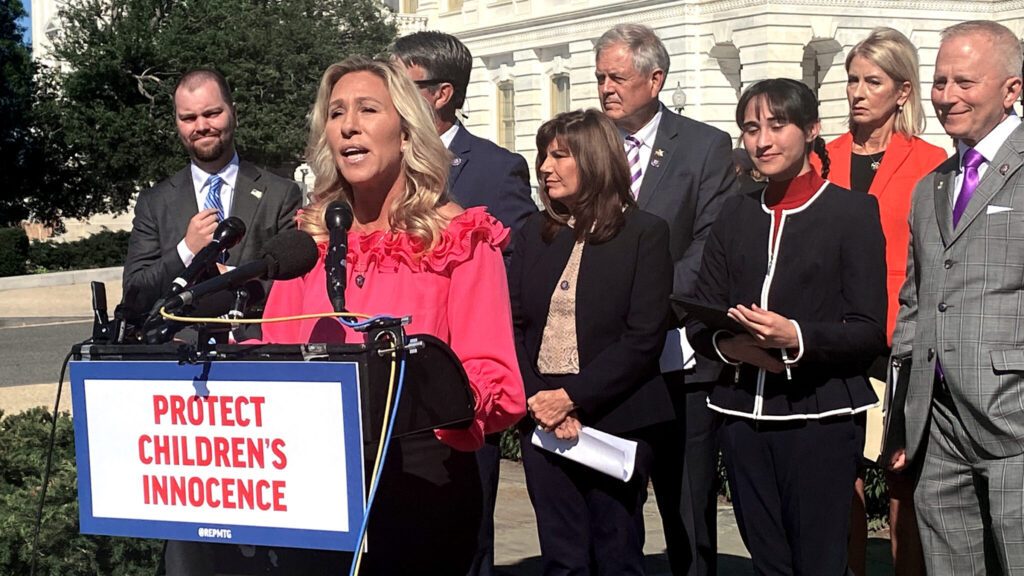
Equally important is the impact on public discourse and social perception. By centering debate on a highly visible, emotionally charged subset of the population—transgender youth—the legislation has intensified national conversations about parental authority, medical ethics, and the role of government in personal health decisions. Continue reading…