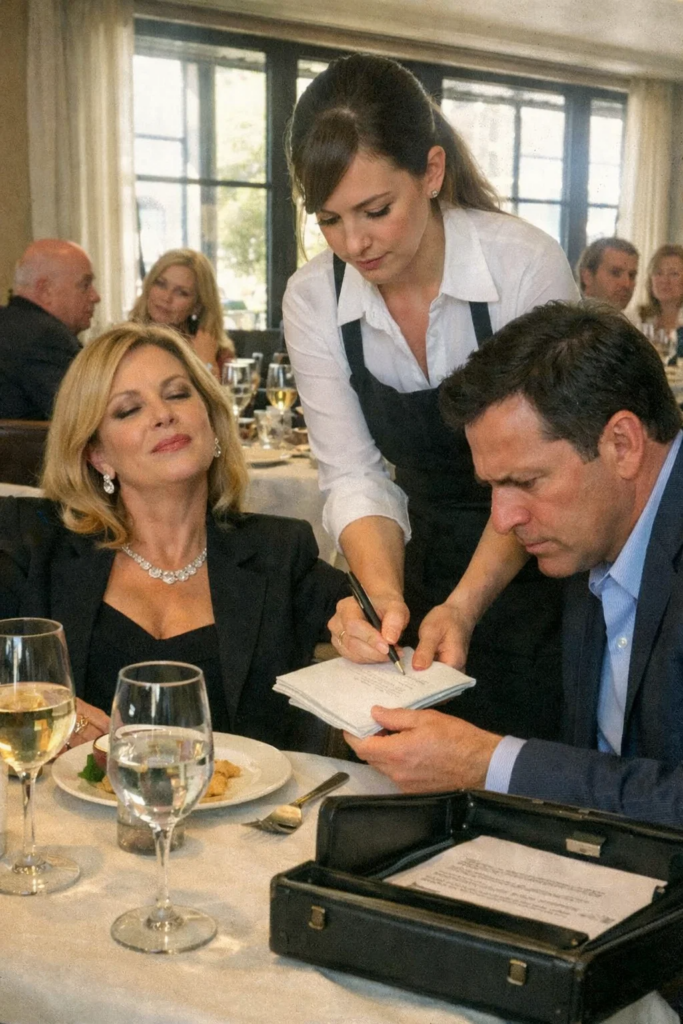
Her name, as Casey had overheard during the reservation check, was Victoria Langford.
Her husband, Nathaniel Langford, was the kind of man whose authority required no volume; he spoke rarely, observed constantly, and carried himself with the quiet assurance of someone accustomed to being listened to.
Victoria, on the other hand, filled every silence.
“This water is too warm,” she said within moments of sitting down, barely glancing at Casey. “And the glasses—are they always this thin? They feel cheap.”
“I’ll bring you a fresh bottle, ma’am,” Casey replied, her tone even, her posture relaxed in the precise way that made her presence efficient but unobtrusive.
“And the menu,” Victoria continued, flipping it open with a faint frown. “Why is everything in French? This is New York, not Paris.”
“It reflects the restaurant’s concept,” Casey said. “I’d be happy to walk you through the dishes.”
Victoria’s lips curved, not quite into a smile. “Or you could bring someone who actually understands it.”
There it was.
Not a misunderstanding. Not a request.
A performance.
Several nearby tables had already begun to take notice, their attention subtle but unmistakable, because moments like this carried a certain social gravity—people were drawn to them even when they pretended otherwise.
Casey inclined her head slightly. “Of course.”
She did not move.

Victoria’s expression sharpened. “Did you hear me?”
“I did,” Casey said calmly. “You asked for someone who understands the menu. That would still be me.”
A flicker of irritation crossed Victoria’s face, quickly replaced by something colder. “That’s surprising,” she said. “You don’t look particularly… academic.”
The word hung in the air, carefully chosen.
Casey let a small breath pass, not quite a sigh, more like the release of something she had already decided she would not carry further.
“I assure you,” she replied, “appearances can be misleading.”
Victoria laughed lightly, turning toward her husband as if inviting him into the moment. “Did you hear that? She assures me.”
Nathaniel glanced up briefly, his gaze moving between them, assessing rather than engaging. “Victoria,” he said quietly, “just order.”
But Victoria was not finished.
“No,” she said, waving a hand dismissively. “I want to understand what I’m eating. That seems reasonable, doesn’t it? Or is that too complicated?”
Her eyes returned to Casey, and this time, the smile that followed carried something unmistakably deliberate.
“Unless, of course, explaining it requires literacy.”
The word landed louder than the first, amplified by intent.
For a heartbeat, nothing moved.
Then Casey reached into the pocket of her apron.
The motion was small, almost unremarkable, but it drew attention precisely because it broke the expected pattern—because she was not stepping back, not deflecting, not retreating into the invisibility the room assumed of her.
She pulled out a pen.
“Would you prefer a written explanation?” she asked, her voice still level, though something beneath it had changed, something firmer, more defined.
Victoria blinked, thrown slightly off rhythm. “I would prefer competence,” she said sharply.
Casey nodded once, then reached for a folded linen napkin on the table.
At that moment, Nathaniel’s attention shifted fully.
Not to the menu.
Not to his wife.
But to Casey’s hands.
His briefcase, resting open beside him, had shifted just enough to reveal the edge of a document—dense text, tightly spaced, unmistakably legal in structure—and as Casey began to write, her pen moved with a speed and precision that did not match the image Victoria had constructed.
Line after line appeared on the napkin, not approximations, not summaries, but exact transcriptions.
Nathaniel leaned forward slightly.
Victoria frowned. “What are you doing?”
Casey did not look up. “Demonstrating comprehension.”
The room, sensing the shift, grew quieter.
When she finished, Casey set the pen down and slid the napkin gently toward Nathaniel.
He picked it up, his expression unreadable as his eyes moved across the text.
For a long moment, he said nothing.
Then, very softly, he exhaled.
“That’s accurate,” he said.
Victoria’s confusion sharpened into irritation. “Accurate of what?”
Nathaniel placed the napkin down carefully. “A clause from the contract in my briefcase.”
The words landed with a weight that rippled outward.
Casey met Victoria’s gaze, not challengingly, but directly.
“It outlines a condition,” she said, “under which a public incident involving either party could significantly alter the financial terms of a separation.”
Victoria’s face lost color.
“What are you talking about?” she demanded, though her voice had already begun to fracture.
“Specifically,” Casey continued, her tone unchanged, “it reduces the settlement by a substantial margin if reputational damage can be demonstrated.”
The silence that followed was no longer passive.
It was charged.
“You have no right—” Victoria began, her voice rising, but before she could finish, she reached for her glass and, in a sudden, uncontrolled motion, threw its contents toward Casey.
The water struck her shoulder, darkening the fabric of her uniform.
A collective intake of breath moved through the room.
Nathaniel stood.
“Enough.”
The word was not loud, but it cut through everything.
Victoria froze, her chest rising and falling quickly.
“You’ve just made this very expensive,” Nathaniel said, his voice controlled in a way that suggested the opposite of calm.
“This is absurd,” Victoria snapped. “She provoked me—”
“No,” he said, meeting her eyes with a steadiness that left no room for argument. “You did that yourself.”
He reached into his jacket, pulled out a checkbook, and wrote something with quick, decisive strokes before tearing the page free and placing it on the table in front of Casey.
“For the incident,” he said.
Casey glanced at it briefly.
Ten thousand dollars.
Not a gesture of generosity.
A calculation.
“Thank you,” she said simply.
Nathaniel nodded once, then turned to Victoria. “We’re leaving.”
“I am not—” she began, but whatever she intended to say dissolved under the weight of his gaze.
They left together, though not side by side.
The door closed behind them.
For a moment, no one moved.
Then, slowly, the room exhaled.
A quiet ripple of applause began, hesitant at first, then growing, not loud, but sincere in a way that mattered more.
Casey stood there for a second longer, then reached for a clean napkin, folded it neatly, and continued her shift.
Because the moment, as significant as it felt, was not the end of anything.
It was the beginning.
—
Three weeks later, she received a call.
“Ms. Bennett,” Nathaniel’s voice came through the line, measured as always. “I’d like you to review something for me.”
“What kind of document?” she asked.
“A contract,” he said. “One that requires… attention to detail.”
She hesitated, not because she doubted her ability, but because she understood what stepping into that world meant.
“And if I decline?” she asked.
“Then I’ll assume you prefer to remain underestimated,” he replied.
There was no arrogance in the statement.
Only observation.
“I’ll look at it,” she said.
That first review turned into another.
Then another.
What began as a single task became a pattern, because Casey saw things others missed—not through brilliance alone, but through patience, through the quiet habit of noticing what didn’t quite align.
A misplaced clause.
An outdated term buried in a translated addendum.
A liability hidden in language that assumed no one would read closely enough to question it.
Within months, she was no longer a waitress who happened to understand contracts.
She was someone whose insight carried weight.
Nathaniel offered her a position—chief of staff, strategic advisor, a role with more influence and compensation than anything she had previously imagined.
But Casey did not accept immediately.
Because recognition, while valuable, was not the same as freedom.
—
The past, however, does not always remain where it belongs.
Victoria returned.
Not in person, but through statements, through carefully crafted narratives that framed Casey as manipulative, opportunistic, someone who had engineered the entire incident for personal gain.
The story spread.
Opinions divided.
And for a brief moment, the same system that had once dismissed Casey threatened to reshape her again into something convenient.
Nathaniel did not intervene immediately.
“Bring me proof,” he said simply. “Not arguments.”
So Casey did what she had always done.
She paid attention.
Three days later, she walked into a shareholder meeting wearing the same uniform she had worn that night, not as a statement of defiance, but as a reminder—to herself more than anyone else—of where she had started.
The room quieted.
She spoke without raising her voice, laying out evidence piece by piece, tracing inconsistencies in language, identifying patterns that pointed not to truth, but to fabrication.
The accusations unraveled.
Not dramatically.
Not loudly.
But completely.
When she finished, there was no applause.
Only silence.
The kind that follows certainty.
—
Six months later, Professor Casey Bennett stood at the front of a lecture hall, sunlight filtering through tall windows, illuminating rows of students who watched her with a focus she had once reserved for others.
Her mother sat in the front row, healthier now, her presence steady and proud.
Casey set her notes aside, though she barely needed them.
“Language,” she said, “is not just communication. It’s structure. It reveals intention, whether we want it to or not.”
She paused, letting the words settle.
“And intelligence,” she continued, “does not announce itself. It doesn’t come with a uniform, or a title, or a seat at a particular table.”
In the back of the room, Nathaniel stood quietly, unnoticed by most.
Casey met the gaze of her students, her voice calm, certain.
“Never assume you know someone’s worth based on where you meet them,” she said. “And never underestimate the person who reads the fine print.”
She smiled then, not in triumph, but in understanding.
Because she had not shattered anyone’s world.
She had simply refused to let hers be defined by it.
And in doing so, she had built something far more lasting than revenge.
She had built a life that no insult could ever diminish.