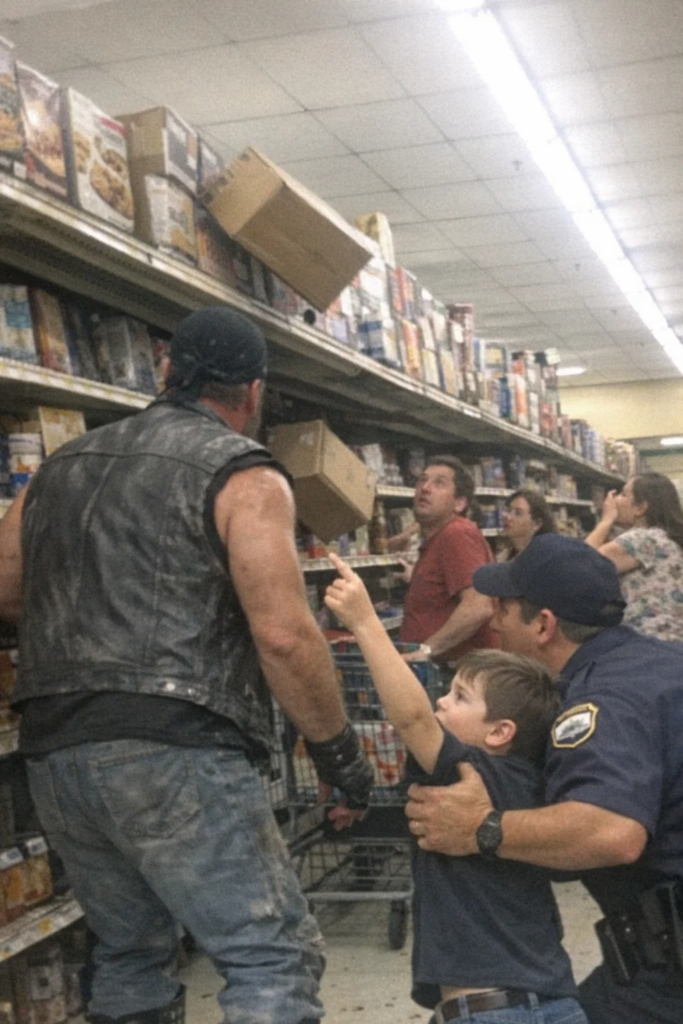
but if you asked the people in that store on that afternoon, before aisle seven collapsed into noise and dust and shock, they would have told you he was the kind of man you kept your distance from.
The boy who grabbed his sleeve did not keep his distance.
The store was loud in the ordinary way that meant no one was really listening to anything—shopping carts rattling, scanners beeping, a child crying somewhere near the front, a tired voice over the speaker announcing a discount on cereal that no one was paying attention to—and in the middle of all that noise, a small hand grabbed a fistful of worn leather and pulled like it was holding onto the only solid thing in a moving world.
Raymond looked down slowly, not angry, not surprised, just focused, and what he saw was not a misbehaving child or a lost kid or a prank, but a boy with wide eyes and a face that was too serious for his age, the kind of serious that doesn’t come from imagination but from seeing something you don’t yet know how to explain.
“Kid,” Raymond said in a calm, even voice, “you okay?”
The boy didn’t answer right away. He pulled again, harder, and pointed behind Raymond toward the end of the aisle, his fingers shaking not with panic but with urgency, like time was a door that was about to close.
“Please,” the boy whispered, and the word was so quiet Raymond might not have heard it if he hadn’t been looking directly at him.
Around them, people noticed the scene but not the reason. A large man in biker gear. A small child grabbing him. It looked wrong in the simple way that made people react before they understood.
“Hey, let go of him,” someone said sharply.
A security guard started walking toward them, already prepared to solve a problem he thought he understood.
Raymond didn’t move. He followed the direction of the boy’s finger instead, his eyes traveling up the metal shelving unit at the end of the aisle, past the rows of canned food and bulk boxes stacked high, higher than they should have been, all the way to the top shelf where something looked… off.
Most people don’t notice small movements in stable things because stable things are not supposed to move, but Raymond had spent years working construction before life had taken him in other directions, and he knew what weight looked like when it wasn’t sitting right.
The shelf was leaning forward just slightly, not enough to cause alarm if you weren’t looking for it, but enough that the top row of heavy boxes had shifted closer to the edge than they were meant to be, and every time a cart bumped the base of the shelf, the entire structure trembled in a way that metal should not tremble.
The boy pulled his sleeve again, more urgently now. “It’s going to fall,” he said, his voice barely steady.
The security guard reached them and put a hand on the boy’s shoulder. “Son, you can’t grab people like that. Come on, let go.”
The boy twisted, trying to point again. “No, you don’t understand—”
“Sir, I’m going to need you to step back,” the guard said to Raymond, already positioning himself between the man and the child, already writing a story in his head that had nothing to do with shelves or physics or danger from above.
Raymond didn’t argue. He didn’t raise his voice. He just said one word.
“Look.”
Maybe it was the way he said it, low and certain, like someone who was used to being listened to when things mattered, or maybe it was luck, but the guard hesitated and glanced up.
At that exact moment, a box on the top shelf shifted forward with a long scraping sound that cut through the noise of the store like a line drawn across a page.
Everything after that happened very fast and very slow at the same time.
The first box fell straight down and hit the floor with a heavy thud that made people jump and turn, confusion crossing their faces as their brains tried to catch up with what their eyes were seeing.
“Move,” Raymond said, not shouting yet, just firm.

Then the shelf groaned, a deep metal sound that meant weight was moving and gravity was about to win.
“MOVE!” he shouted, and this time his voice filled the aisle.
He lunged forward, grabbed a man who was standing directly beneath the shelf and pulled him backward so hard the man nearly fell, then shoved a shopping cart sideways to clear space as more boxes began sliding, faster now, the entire top row tipping forward like a line of dominoes.
A woman screamed. Someone dropped a glass jar that shattered on the floor. The security guard grabbed the boy and pulled him back just as the metal frame gave a loud, twisting crack.
Then the shelf came down.
Boxes, cans, and metal crashed into the space where people had been standing seconds earlier, the noise so loud that for a moment it seemed like the entire store had gone silent just to listen to it.
When the sound stopped, there was a strange, heavy quiet, the kind that comes after something almost terrible happens but doesn’t, and people looked at the pile of fallen metal and scattered goods and then at the empty space in front of it where bodies should have been.
Raymond stood there breathing hard, one hand still gripping the shoulder of the man he had pulled out of the way.
The boy stood a few feet away, the security guard’s hand still on his shoulder, his small face pale but steady.
Slowly, very slowly, people began to understand what had actually happened, and the looks they gave the boy and the man in the leather vest were not the same looks they had given them two minutes earlier.
The boy’s mother came running from another aisle, her face full of fear that only got worse when she saw the fallen shelf and her son standing near it.
“What happened?” she asked, pulling him into her arms, her voice shaking.
“I tried to tell them,” the boy said quietly into her jacket. “It was moving.”
Raymond walked over and crouched down so he was eye level with the kid, his expression softer now, the hard edges gone. “You saw it before anyone else did?”
The boy nodded. “It kept leaning. Every time a cart hit it, it moved a little more.”
Raymond gave a small nod, the kind men give each other when something important has been understood without needing a long explanation. “You did the right thing,” he said. “You didn’t ignore it.”
The security guard cleared his throat, looking embarrassed now, his earlier confidence gone. “I thought… I mean, it looked like…” He stopped, because there wasn’t a good way to finish that sentence.
Raymond stood up and clapped the guard lightly on the shoulder. “You were doing your job,” he said. “Just happened fast.”
But the guard still looked at the boy differently now, like he was seeing him for the first time instead of seeing a problem that needed to be handled.
The store manager arrived, then more employees, then people with tools and radios and serious faces, and slowly the aisle filled with the kind of controlled chaos that follows an accident that almost became a tragedy.
Through all of it, the boy stayed close to his mother, and every now and then he looked over at Raymond, just to make sure he was still there, just to make sure that the person who had understood him when no one else did had not disappeared back into the crowd.
Before Raymond left, he walked over one more time and held out his hand. The boy looked at it, then shook it with a seriousness that made Raymond smile a little.
“What’s your name, kid?” Raymond asked.
“Elliot,” the boy said.
“Well, Elliot,” Raymond replied, “you probably saved a lot of people today.”
Elliot frowned slightly. “You pulled them away,” he said. “I just saw it.”
Raymond shook his head once. “Seeing something and doing nothing is easy,” he said. “Seeing something and grabbing a stranger twice your size in a crowded store? That’s not easy.”
Elliot thought about that for a moment like it was something he would store away and remember later when he was older.
They left after that, Elliot and his mother, whose name was Claire, and life should have gone back to normal the way it usually does after something almost bad happens, but sometimes the world doesn’t reset completely, sometimes it remembers.
About a week later, on a quiet Saturday afternoon, the low sound of motorcycle engines rolled into the small street where Claire and Elliot lived, not loud in an aggressive way but steady, like a group of people arriving together with a purpose.
Neighbors looked out their windows as a line of bikes parked along the curb, sunlight glinting off chrome and helmets, and Raymond stepped off the first bike and walked up to the small house with a cardboard box in his hands.
He knocked once, then waited.
Claire opened the door, confusion crossing her face when she saw him, followed quickly by recognition. Elliot appeared behind her a second later, his eyes widening in surprise.
“Hey, kid,” Raymond said, lifting the box slightly. “Told you I’d come by sometime.”
“You didn’t say that,” Elliot replied honestly.
Raymond chuckled. “Guess I forgot to say it out loud.”
Behind him, a few other riders were unloading things from saddlebags and another truck that had pulled up—bags of groceries, a toolbox, a couple of folded shelves still in their packaging.
Claire looked overwhelmed. “You don’t have to do this,” she said. “Really, you don’t.”
Raymond shrugged slightly. “Maybe not,” he said. “But we wanted to.”
One of the other riders, an older woman with gray streaks in her hair and kind eyes, stepped forward and handed Claire an envelope. “For the boy,” she said. “For school stuff. Or books. Or whatever he needs.”
Claire tried to protest again, but Elliot looked up at her and then at Raymond and said quietly, “He listened when nobody else did.”
Raymond tapped the edge of his leather sleeve lightly. “You grabbed right here,” he said. “Hard, too.”
Elliot smiled a little for the first time since the store. “I thought you were the only one strong enough to move people fast.”
Raymond considered that for a moment, then nodded. “Fair enough,” he said.
They spent maybe twenty minutes there, not long, just long enough to bring the boxes inside and put the new shelves in the garage and make sure Claire knew how to contact them if she ever needed help with repairs or anything else.
Gratitude, when it’s real, is usually quiet and practical.
Before he left, Raymond crouched down again so he was eye level with Elliot. “You keep paying attention to things,” he said. “Most people walk through the world half asleep. Don’t be like that.”
Elliot nodded seriously. “Okay.”
“And if you ever see something that’s not right,” Raymond added, “you don’t stay quiet, even if people misunderstand at first.”
Elliot glanced at the leather sleeve again, then back at Raymond. “I won’t,” he said.
The engines started again a few minutes later, the sound rolling down the street as the bikes pulled away one by one, neighbors still watching from windows, the afternoon sun turning everything gold and calm again.
Claire stood on the porch with her arm around Elliot’s shoulders, both of them watching until the last bike turned the corner and disappeared.
“What were you thinking,” she asked softly, “when you ran up and grabbed a stranger like that?”
Elliot leaned into her slightly, thinking carefully before answering, the way he always did when he wanted to get something exactly right.
“I wasn’t thinking about him,” he said. “I was thinking about the shelf falling on the people. He was just the person who could help the fastest.”
Claire looked down at him, her eyes warm and a little proud and a little shaken at the same time. “You know,” she said, “a lot of adults saw that shelf and didn’t really see it.”
Elliot nodded. “People see what they expect,” he said. “They didn’t expect it to fall.”
Claire squeezed his shoulder gently. “And what do you expect?” she asked.
Elliot thought for a long moment, watching the empty street where the motorcycles had been.
“I think,” he said slowly, “that if something looks wrong, you should trust that feeling and try to help, even if people think you’re making a mistake.”
Claire smiled and kissed the top of his head. “That sounds like a pretty good rule,” she said.
Inside the house, on the small table near the door, the envelope the riders had left sat unopened for a while before Claire finally picked it up later that evening.
Inside was a simple card with a short message written in careful block letters:
For the kid who paid attention when nobody else did.
Under the message was a check that Claire stared at for a long time, her hand covering her mouth as she realized that what her son had done in a noisy supermarket on an ordinary afternoon had traveled farther than that aisle, farther than that day, into the lives of people who understood what it meant when one person spoke up and another person chose to listen.
Years later, Elliot would barely remember the details of the store, the noise, the falling boxes, or the way people had looked at him before they understood, but he would always remember the moment a stranger stopped, followed his finger, and said one simple word that changed everything before it was too late.
Look.
And he would remember that sometimes being brave doesn’t look like fighting or shouting or being the strongest person in the room, sometimes it looks like a small hand grabbing a worn leather sleeve in the middle of a crowded place and refusing to let go when something isn’t right, even when the whole world thinks you’re the one causing trouble, right up until the moment they realize you were the one trying to save them all along.