A chipped ceramic mug. A faded photo frame. A blanket worn soft by decades of winters.
“These will fit in your new place,” she said, not unkindly, but with the firm tone of someone who had already made the decision and didn’t intend to revisit it.
Your new place.
He repeated the phrase silently, tasting its distance.
The facility had a pleasant name—Willow Creek Assisted Living—but names, he had learned over eighty-three years, were often the gentlest part of hard truths.
“I don’t need much,” he said quietly.
“I know,” she replied, not looking at him. “That’s why this will be easier than you think.”
Easier.
For whom, he wondered.
He didn’t argue. Not because he agreed, but because he had come to understand that arguments, like certain doors in life, eventually stopped opening no matter how firmly you pushed.
So instead, he wandered.
Not far—never far enough to alarm her—but just beyond the edges of her urgency, where the air felt less like a checklist and more like something he could still claim for himself.
Thrift stores held a particular kind of silence. Not the peaceful kind, but something layered—like echoes trapped in objects. Every item had belonged to someone once. Every shelf carried fragments of lives interrupted, reorganized, or quietly forgotten.
He moved slowly along the back aisle, his fingers grazing fabrics as though reading a language only time could translate.
And then he saw it.
Olive green.
Heavy canvas.
Hanging crooked, as if even gravity hadn’t decided whether to let it stay or fall.
For a moment, he simply stared.
Then something inside him shifted—deep, sudden, undeniable.
His hand lifted before his mind could stop it.
The sleeve was frayed at the cuff.
The zipper slightly misaligned.
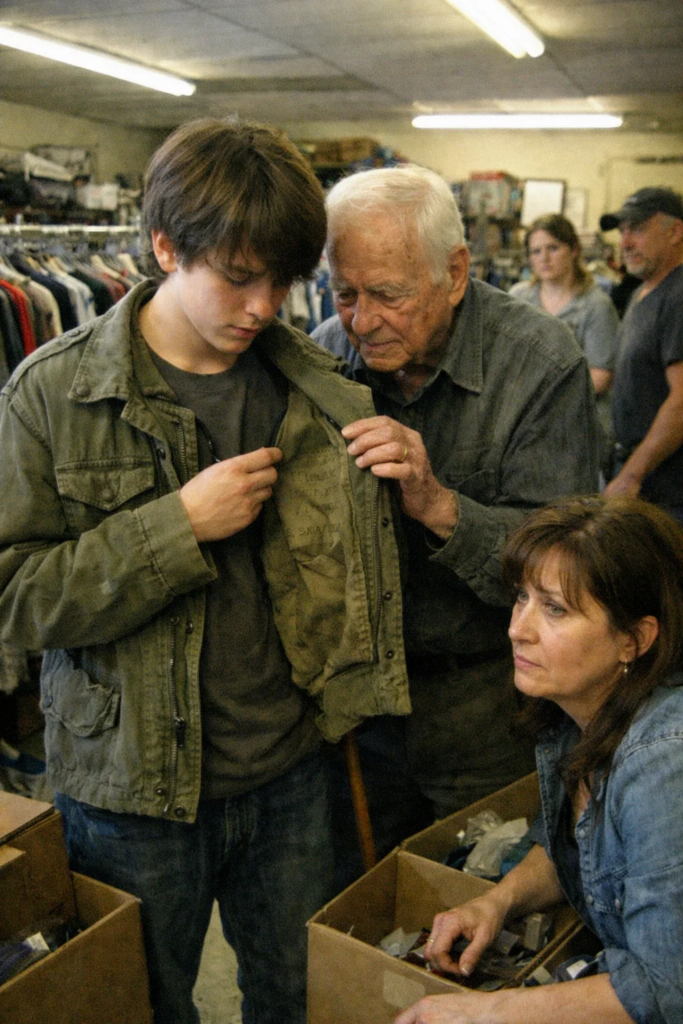
And when he turned it, gently, carefully, as if afraid it might disappear if handled too quickly, he saw them.
Four names.
Written in faded ink along the inner lining.
HARRIS
MORALES
“DOC” KELLEY
ARCHER
His breath caught.
The store faded.
The present loosened its grip.
And suddenly he was nineteen again, standing beneath a sky too wide to belong to anything peaceful, the air thick with heat and tension and the kind of laughter that came from boys pretending not to be afraid.
Harris had written the names.

“If this thing ever gets lost,” he had joked, holding up the marker, “at least someone’ll know we were here.”
Morales had laughed, shaking his head. “Yeah, because a jacket is definitely how history remembers us.”
“Better than nothing,” Doc Kelley had added, already humming some tune no one else recognized.
They had all laughed then.
Because laughing was easier than thinking.
Because thinking meant imagining futures that might never arrive.
“They were kids,” Samuel murmured to himself, his thumb tracing the ink.
“Man… this jacket is perfect.”
The voice behind him pulled him back.
He turned slowly.
A teenage boy stood there, tall but still carrying the unfinished edges of youth, headphones resting loosely around his neck, his expression open and curious in a way the world hadn’t yet taught him to hide.
“You gonna buy that?” the boy asked. “Because if not… would you mind if I tried it on?”
Samuel hesitated.
Not out of suspicion.
But because the question felt bigger than it sounded.
Still, before he could answer, the boy gently lifted the jacket and slipped it on.
It fit.
Of course it did.
Time had a way of repeating shapes.
The boy turned toward the mirror, adjusting the collar with a small, satisfied smile.
“This is amazing,” he said. “Feels… I don’t know. Real.”
His fingers brushed the inside lining.
He opened it.
And then he stopped.
The shift in his expression was immediate, quiet, and genuine.
“Who are they?” he asked softly.
Samuel stepped beside him, their reflections sharing the same frame—one young, one old, both connected by something neither fully understood yet.
“They were friends,” Samuel said.
The boy looked closer.
“What happened to them?”
Samuel didn’t answer right away.
Because some truths required more than words.
“They stayed young,” he said finally.
The boy swallowed.
Carefully, almost reverently, he took the jacket off.
“You should keep it,” he said. “It’s yours.”
Samuel looked at it—really looked.
At the fabric that had outlived the boys who wore it.
At the ink that had survived decades of silence.
At the weight of memory that had somehow found its way back to him, only to ask what he intended to do with it now.
If he took it with him, it would hang in a small closet.
One day, it would be sorted again.
Labeled.
Moved.
Forgotten.
He pushed it gently back toward the boy.
“Take it,” he said.
The boy blinked. “What?”
“But not as a trend,” Samuel added, his voice steady now.
The boy listened.
“If anyone asks,” Samuel continued, tapping the lining, “you show them those names. You tell them Harris wanted to open a garage with his brother. You tell them Morales never stopped talking about his family. You tell them Kelley patched us up and pretended he wasn’t scared.”
The boy nodded slowly.
“And you tell them,” Samuel finished, “that this isn’t just a jacket.”
“It’s what’s left of people who deserved to be remembered.”
The boy’s expression changed—not dramatically, but enough.
“I will,” he said.
And Samuel believed him.
When he returned to the front of the store, his daughter was waiting, impatience barely hidden.
“Where did you go?” she asked. “We’re running out of time.”
He looked at her.
Then at the cart.
Then at the door, where the boy had just stepped out into the afternoon light, carrying something far more important than he had expected to find.
“For the first time today,” Samuel said quietly, “I think we’re right on time.”
She didn’t understand.
Not yet.
Three weeks later, life at Willow Creek settled into a rhythm that felt both unfamiliar and strangely predictable. Meals at fixed hours. Conversations that circled familiar themes. Days measured not by ambition, but by routine.
Then one afternoon, there was a knock.
“Mr. Archer?” a staff member said. “There’s someone here to see you.”
Samuel frowned. “Me?”
In the lobby, the boy stood waiting.
The jacket on his shoulders.
But he wasn’t alone.
A teacher.
Two students.
A small camera.
“I found you,” the boy said, smiling.
“How?” Samuel asked.
“I asked questions,” he replied. “Turns out people remember more than you think.”
He hesitated, then added, “I started telling their stories. Now we want to hear yours.”
Something inside Samuel shifted again.
Not backward this time.
Forward.
Later, as voices filled the room—not with noise, but with curiosity, with listening, with the kind of attention that gives meaning back to memory—his daughter arrived.
She stopped in the doorway, confused.
“What’s going on?” she asked.
Samuel looked at her.
Really looked.
“Someone’s remembering,” he said.
She watched as the boy carefully opened the jacket, showing the names, speaking them aloud with quiet respect.
And something in her expression softened.
For the first time in a long while, she didn’t see a man to manage.
She saw a life.
And in that moment, the boxes didn’t seem quite so final anymore.
Because some things, Samuel realized, don’t belong in storage.
They belong in stories.
And as long as someone is willing to listen—
no life is ever truly packed away.