I didn’t react right away, not because I wasn’t hurt, but because a part of me had been expecting this moment for three years—just not like this, not in front of half the town, not with my husband standing right there beside me pretending that looking down at the grass somehow made him invisible.
“Eleanor,” I said quietly, forcing my voice into something steady, something that didn’t betray the heat rising behind my eyes, “you’re making a scene.”
“Oh, I’m making a scene?” she repeated, her voice climbing with a brittle kind of disbelief that made the women around her lean in instead of stepping back. “You walk into my family wearing that, and I’m the one making a scene?”
Her gaze locked onto the necklace at my throat—the Seraphina Heart, heavy and warm against my skin, a piece Julian had clasped around my neck a year ago with a smile that felt, at the time, like belonging.
“It was Julian’s grandmother’s,” I said, touching it instinctively. “He gave it to me.”
“I know exactly what it is,” Eleanor snapped, and before I could process the shift in her expression—from polished disdain to something raw and almost feral—she stepped forward and grabbed it.
Everything after that happened too fast and too slow at the same time.
Her fingers were cold against my skin, sharp with intent, and then there was a sudden, violent pull—
—and a metallic snap that cut clean through the air.
Pain flared at the back of my neck as the chain broke, and I stumbled backward, my hand flying up instinctively, my breath catching somewhere between shock and disbelief.
Eleanor stood there, clutching the locket in her hand like she had just reclaimed something stolen from her, her chest rising and falling in uneven bursts.
“You don’t get to wear her legacy,” she said, her voice trembling—not with rage now, but with something deeper, something closer to fear. “You don’t belong in this family. You never did.”

I looked at Julian.
He didn’t look back.
That hurt more than anything she had said.
But then something shifted.
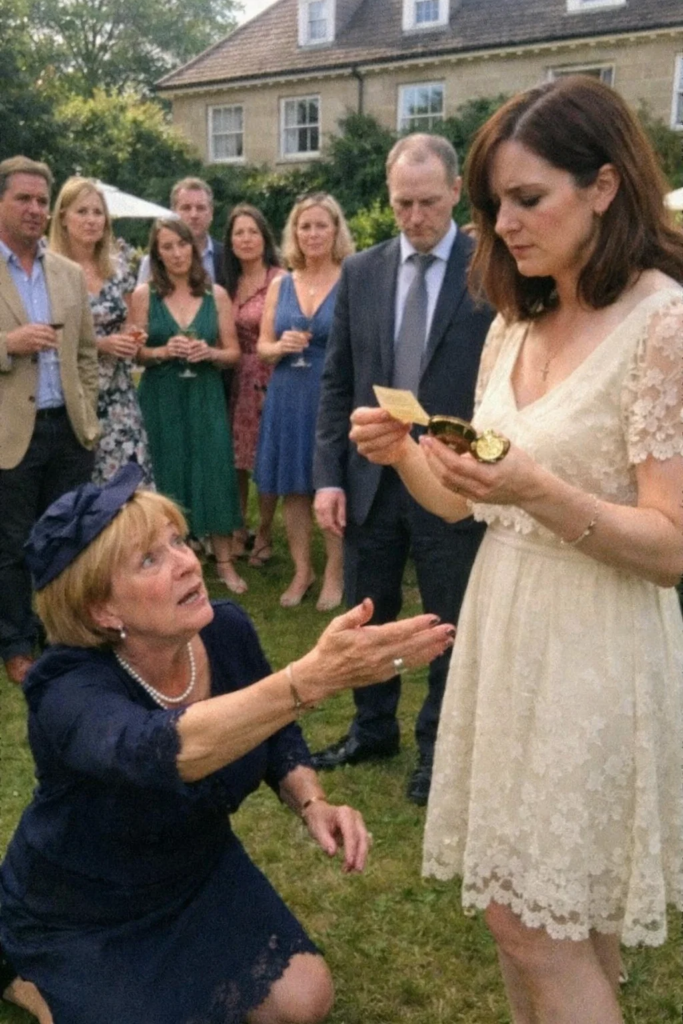
Because the locket didn’t just open—it broke.
A small, folded piece of yellowed vellum slipped from its hidden compartment and drifted down onto the perfectly trimmed grass between us, landing softly like it didn’t understand it had just changed everything.
Eleanor froze.
And in that single second, I saw it—the truth behind her cruelty, the thing she had spent decades burying beneath money and reputation and control.
Fear.
“Give it to me,” she said, dropping to her knees without a second thought, her voice stripped of all authority. “Evelyn, please. You don’t know what you’re doing.”
But I was already moving.
I picked it up before she could reach it, my fingers trembling slightly as I unfolded the fragile paper, aware of the entire crowd watching, waiting, holding their breath for something none of them yet understood.
“I thought I wasn’t family,” I said quietly, my eyes still on the ink as the words came into focus. “Why does this matter now?”
No one answered.
So I read.
And the world, as I knew it, tilted.
“The debt is settled. The girl is gone. The boy is yours, but the blood is mine. Never let the archives speak the name Seraphina again.”
For a moment, I couldn’t breathe.
Then I looked up—at Eleanor, still on her knees, her composure shattered; at Julian, whose face had gone pale in a way that made something inside me turn cold; at the house behind them, suddenly less like a home and more like a stage set built on secrets.
“Oh my God,” I whispered.
Because the parasite wasn’t me.
It never had been.
The party ended without anyone officially saying it was over, guests slipping away in murmurs and sideways glances, their curiosity now heavier than their politeness, leaving behind half-finished drinks and the unmistakable scent of scandal that would carry through every dinner table in town by nightfall.
Inside the house, the silence was suffocating.
Eleanor stood near the window, her back rigid, her hands trembling just enough to betray her.
Julian paced like a man trying to outrun something that lived inside him.
And I stood in the middle of it all, the note still clutched in my hand, the weight of it far heavier than the gold that had once held it.
“Explain it,” I said finally, my voice cutting through the quiet.
“No,” Eleanor replied instantly. “You’ll give that back, and this ends here.”
“Ends?” I let out a short, disbelieving laugh. “You assaulted me in your own backyard and called me a parasite in front of your entire social circle, and you think this ends?”
“It does if you want to keep your life,” she said, turning to face me, her composure snapping back into place piece by fragile piece. “Everything you have comes from this family.”
“I didn’t marry your money,” I said. “I married your son.”
At that, something in Julian finally cracked.
“Then you married the wrong man,” he said quietly.
I turned to him, stunned. “What does that mean?”
He hesitated, just for a second, and in that hesitation, I saw the truth—he knew.
Maybe not everything. Maybe not all at once.
But enough.
“She’s right about one thing,” he said, his voice flat now, controlled in a way that felt far more dangerous than anger. “This doesn’t leave this house.”
“Why?” I asked. “Because it ruins your reputation? Or because it exposes what you really are?”
His jaw tightened.
“You think you’re better than this?” he shot back. “You think you wouldn’t choose the same if you had everything on the line?”
“I wouldn’t build my life on someone else’s disappearance,” I said.
That landed.
Hard.
Eleanor stepped forward. “Careful, Evelyn.”
“No,” I said, my voice rising for the first time. “No, I’ve been careful for three years. Careful with my words, careful with my place, careful not to upset you. And where did that get me?”
Neither of them answered.
So I continued.
“The boy is yours, but the blood is mine,” I repeated, holding up the note. “Julian… what does that mean?”
He didn’t respond.
But someone else did.
“Because he isn’t her son.”
We all turned.
Sarah—Eleanor’s assistant, quiet and invisible for years—stood in the doorway, her face pale but resolute.
“Sarah,” Eleanor snapped, “this is not your place.”
“It should have been your place to tell the truth a long time ago,” Sarah said softly.
The room held its breath.
“Julian,” she continued, looking at him now, “your father had a child with a woman named Seraphina. When Eleanor couldn’t conceive, she arranged for that child to be taken and raised as her own. The locket was Seraphina’s. It was the only thing she had left of him.”
Julian didn’t move.
Didn’t speak.
But something in his expression shifted, like a crack forming in glass.
“That’s not true,” he said finally, but it sounded like he was trying to convince himself more than anyone else.
“It is,” Sarah replied. “And the note you’re so afraid of? It’s proof.”
Eleanor stepped forward, her voice sharp again. “Enough. This ends now.”
“No,” I said, pulling my phone from my pocket. “It doesn’t.”
“What are you doing?” Julian demanded.
“Ending it properly.”
I didn’t call the police.
I called a journalist.
Because if there was one thing Eleanor Vance feared more than losing control, it was losing reputation.
By the time the story broke, it didn’t just shake the Vance name—it shattered it.
Old records resurfaced. Questions turned into investigations. The “perfect” history Eleanor had curated began to unravel, thread by thread, until the truth stood exposed for everyone to see.
There was no quiet recovery from that.
Eleanor lost everything she had spent a lifetime protecting—her standing, her influence, the illusion of control she had built her identity around.
Julian tried to hold onto it.
For a while, he even blamed me.
But truth has a way of settling where it belongs.
Months later, when the dust had finally begun to settle, he showed up at my door—not in designer linen, not with rehearsed composure, but as something closer to human.
“I didn’t know who I was without it,” he admitted, his voice quieter than I had ever heard it.
“And now?” I asked.
He hesitated.
“I’m trying to find out.”
I nodded.
But I didn’t let him in.
Because some things, once broken, don’t return to what they were—and maybe they’re not supposed to.
As for me, I left Connecticut behind.
I went back to something simpler, something real, something that didn’t require me to prove my worth to people who measured it in inheritance and appearances.
And sometimes, late at night, I think about that moment in the garden—the snap of gold, the silence, the truth falling into the open.
Eleanor called me a parasite.
But in the end, she revealed something far more dangerous.
Not everything that looks like legacy is earned.
And not everything that calls you an outsider is a place you were ever meant to belong to begin with.
Some things have to break…
so the truth can finally breathe.