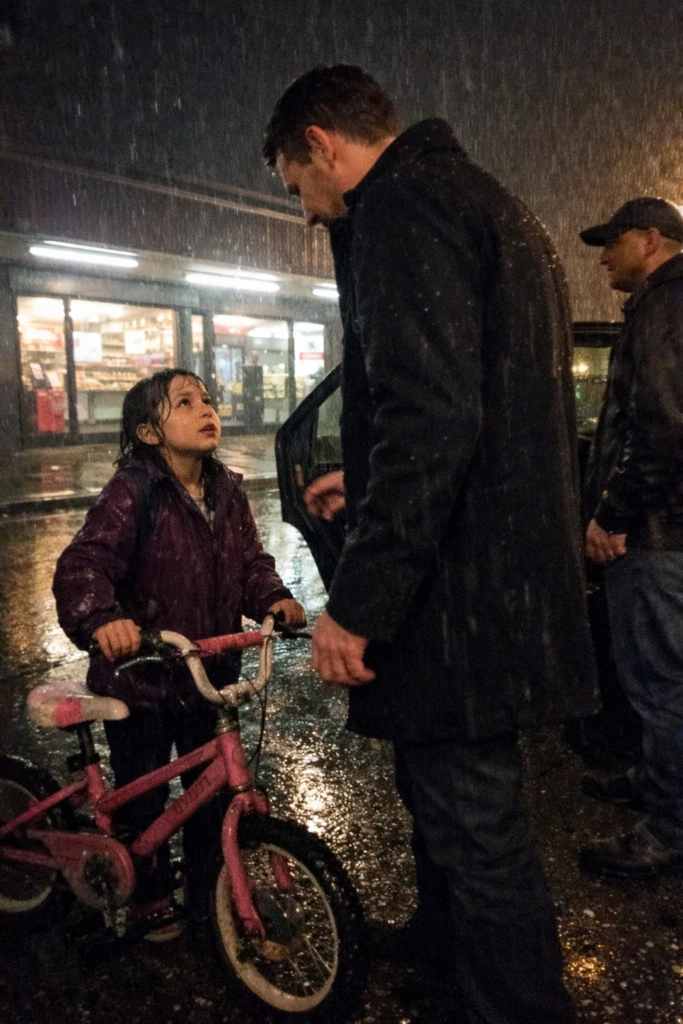
It had just started raining when the black SUV rolled to a stop outside a dimly lit convenience store on the edge of the city, the kind of place that stayed open late not because it was profitable but because people in that neighborhood had nowhere else to go, and when the driver’s door opened, Vincent Caruso stepped out with the quiet authority of a man who didn’t need to announce who he was because the world around him already knew.
He was used to people lowering their voices when he walked in, used to doors opening before he knocked, used to fear doing half his work for him, and yet that night, before he could even take out his phone, a voice behind him cut through the rain in a way that didn’t sound like fear at all.
“Sir… would you buy my bike?”
He turned, slowly, more out of curiosity than anything else, and found himself facing a girl who looked no older than eight, standing there in soaked clothes that clung to her thin frame, her hands gripping the handlebars of a faded pink bicycle whose paint had chipped away in places as though time itself had been trying to erase it.
Her shoes were worn through at the edges, her hair stuck to her face in damp strands, but what held him there wasn’t her appearance—it was her eyes, steady despite everything, carrying a kind of exhaustion no child should ever understand.
Vincent frowned slightly, not unkindly, but with the confusion of someone encountering something that didn’t fit the rules of his world.
“What are you doing out here alone?” he asked.
She pushed the bike forward, her small arms trembling from the effort.
“Please,” she said, her voice wavering just enough to reveal the strain behind it. “My mom hasn’t eaten. I tried selling other things, but… there’s nothing left.”
Something shifted in Vincent’s chest, something he didn’t recognize at first because it had been a long time since anything had reached him without calculation.
“How long?” he asked quietly.
She hesitated, as if the answer itself might cause trouble.
“A few days,” she whispered. “Since they came.”
Vincent’s expression hardened slightly.
“Who came?”
The girl glanced around instinctively, even though the street was empty except for the steady fall of rain against cracked pavement.
“The men,” she said. “They said my mom owed money. They took everything. The couch, the TV… even my brother’s crib.”
Vincent’s jaw tightened.
He had heard stories like that before. Too many.

But those stories were supposed to belong to other men.
Not his.
“And your mom?” he asked.
“She’s at home,” the girl said. “She doesn’t get up much anymore. She says it’s easier to stay still.”
There was something in the way she said it that made Vincent look at her more closely, and when she shifted her sleeve to wipe rain from her face, he noticed the faint discoloration along her arm—not dramatic, not obvious, but enough to suggest something had gone wrong somewhere along the line.
“They told us not to tell anyone,” she added softly. “But I recognized one of them.”
Vincent stepped closer, his voice dropping into something quieter, more focused.
“Who was it?”
She looked at him directly, as though measuring whether he was someone she could trust, which was almost ironic given who he was.
“One of your men,” she said.
For a second, Vincent didn’t move.
Not because he felt accused.
But because he understood exactly what that meant.
Someone had used his name, his reputation, the shadow he cast over the city, and twisted it into something he had never allowed within his operation—taking from people who had nothing, hiding behind fear instead of enforcing rules that, in his mind, still had boundaries.
He straightened slowly, the rain darkening his coat.
“Where do you live?” he asked.
The girl pointed down the street, toward a neighborhood that most people avoided after dark.
Vincent nodded once, then reached into his pocket and pulled out his keys.
“Get in,” he said.
She hesitated.
He held her gaze, steady.
“I’m not buying the bike,” he added. “I’m fixing the problem.”
The drive felt longer than it should have, not because of distance but because of the silence that settled between them, broken only when he finally asked her name.
“Rosie,” she said.
“And your mom?”
“Lena.”
He repeated it once, quietly, committing it to memory.
The neighborhood she led him to looked forgotten, as if the city had decided it was easier to ignore it than repair it, with broken streetlights casting uneven shadows across boarded windows and narrow sidewalks where no one lingered long enough to be noticed.
He parked in front of a small house whose paint had long since peeled away, leaving bare wood exposed to the weather, and when Rosie stepped out, still holding onto the bicycle as though it were part of her, he followed without hesitation.
“She’s inside,” Rosie said. “She might be asleep.”
Vincent didn’t answer.
He already knew that kind of sleep.
The door opened with a soft creak, revealing a space that had been stripped down to almost nothing—no furniture except a thin mattress in the corner, no decorations, no signs of comfort, just the echo of what had once been there.
And on that mattress lay a woman who looked far older than she probably was, her face pale, her breathing shallow, her body still in the way of someone who had learned to conserve energy because there was nothing left to spend.
“Mom?” Rosie whispered, rushing to her side.
The woman stirred slightly, her eyes opening just enough to register movement.
“Rosie…?” she murmured.
Vincent stood in the doorway for a moment, taking in everything—the emptiness, the silence, the quiet resilience that had somehow kept this child standing when everything else had been taken.
Then he stepped inside.
“My name is Vincent,” he said.
The woman tried to sit up, but her strength failed her halfway.
“You shouldn’t be here,” she said weakly. “If they see you—”
“They won’t,” Vincent replied calmly.
He turned, pulling out his phone.
“Send a team,” he said when the line connected. “Food, medical supplies, and someone to restore power to this address within the hour.”
He paused, then added, his voice turning colder.
“And find out who’s been collecting debts in my name without authorization.”
There was a brief silence on the other end.
“Yes, sir.”
Vincent ended the call and looked back at Rosie, who was watching him with a mixture of hope and uncertainty, as though she didn’t quite believe this was real.
“You’re not selling that bike,” he said gently.
Her grip tightened on the handlebars.
“Really?”
“Really.”
The next forty-eight hours moved faster than anything that had come before.
Food arrived first, then electricity, then people who cleaned, repaired, replaced what had been taken, until the house slowly began to resemble something livable again.
Lena was taken to a clinic, treated, given the care she had gone without for too long, and when she returned, she did so standing a little straighter, her strength beginning to return in quiet, determined increments.
But Vincent’s attention had shifted elsewhere.
Because the men responsible hadn’t just taken from a family.
They had broken a rule he never allowed to be broken.
They had turned fear into cruelty.
It didn’t take long to find them.
A small group operating under the assumption that distance from the center meant they could act without consequence, collecting money from those who couldn’t afford to pay, using his name as a shield.
They didn’t expect him to show up.
Not in person.
Not without warning.
When he did, the room fell silent in a way that carried more weight than any threat.
“You’ve been busy,” Vincent said, his voice calm enough to make it worse.
One of them tried to speak, to explain, to justify.
“We thought—”
“That’s the problem,” Vincent interrupted. “You thought.”
He didn’t raise his voice.
He didn’t need to.
“You take from people who have nothing,” he continued. “You use my name to do it. And you expect me to ignore it?”
“No, sir,” another man said quickly. “We were going to fix it—”
“You already had your chance to do the right thing,” Vincent replied. “You chose something else.”
What happened next didn’t involve chaos or spectacle.
It involved consequences.
The kind that spread quietly through a network until everyone understood exactly where the lines were—and what happened when they were crossed.
By the end of the week, every item taken from Lena’s home had been returned or replaced.
The men responsible were gone from any position where they could harm anyone again.
And something else changed, too.
Because word travels in ways that can’t always be controlled, and soon enough, people began to hear a different version of Vincent Caruso’s name—not just as someone to fear, but as someone who enforced something resembling fairness in a world that rarely offered it.
A month later, Rosie rode her bike down the same street where she had once stood in the rain, her laughter carrying further than it ever had before, her shoes new, her eyes lighter, no longer carrying the same weight.
Vincent watched from across the street, hands in his coat pockets, his expression unreadable to anyone who didn’t know him.
Lena stood beside him.
“I don’t know how to thank you,” she said quietly.
“You already did,” he replied.
She looked at him, confused.
“By raising her the way you did,” he said, nodding toward Rosie. “She asked for help when it mattered. Not everyone does.”
Lena’s eyes softened.
“She saved us,” she said.
Vincent didn’t argue.
Because he knew it was true.
And as Rosie rode past them, waving with a smile that felt like something entirely new, he realized that for all the power he had built, for all the control he had maintained, it had taken a small girl in the rain to remind him of something he had almost forgotten.
Respect isn’t proven by how much you can take.
It’s proven by what you refuse to take at all.
And sometimes, the right thing to do doesn’t come from strength.
It comes from finally remembering where your limits should have been all along.