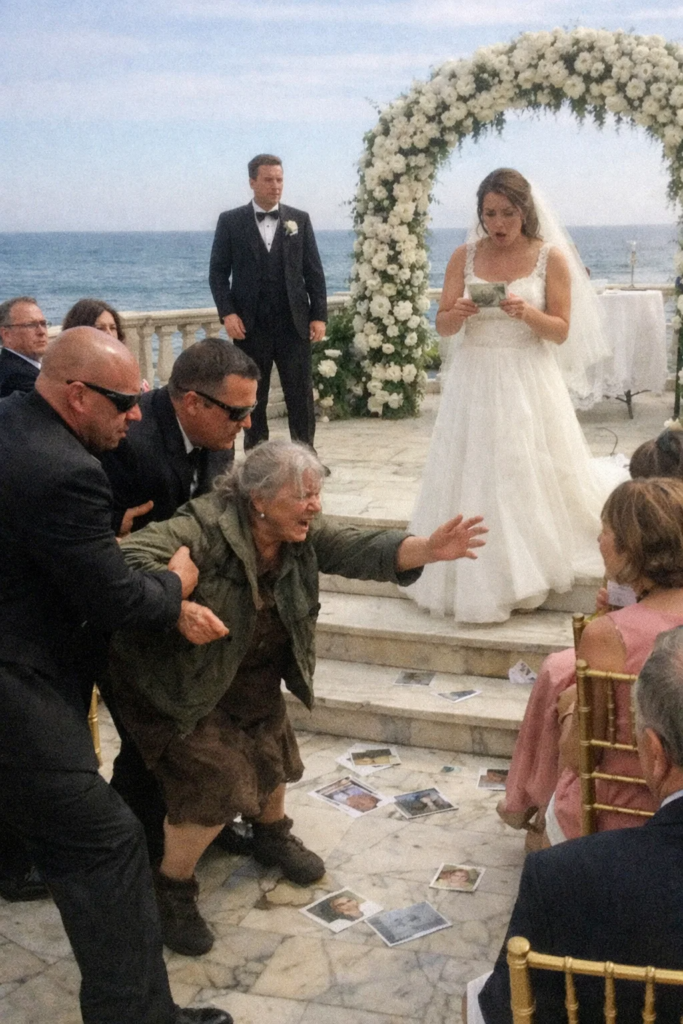
Natalie had spent almost a year planning the ceremony.
But in that moment she was no longer thinking about music, flowers, or the man waiting beside her.
She was staring at the woman being dragged across the marble terrace.
“Please,” the stranger cried, her voice trembling with desperation. “Just let me talk to her. One minute. That’s all I need.”
The guard tightened his grip.
“Ma’am, you need to leave.”
Her small purse slipped from her shoulder as they pulled her back. It struck the ground and burst open, scattering a few faded photographs across the floor like forgotten memories suddenly exposed to sunlight.
At the altar, Natalie felt something strange tighten inside her chest.
She had seen plenty of disruptions at public events before—protesters, confused guests, even the occasional drunken relative—but something about this woman was different.
It was not just her ragged coat or the trembling urgency in her voice.
It was the way she looked directly at Natalie.
Not with anger.
With recognition.
“Natalie,” the woman cried.
The sound of the name seemed to echo across the silent terrace.
Natalie’s fiancé, Christopher Langford, leaned closer.
“Security will handle it,” he whispered.
But the bride was already stepping down from the platform.
Across the terrace, the elderly woman struggled against the guards one last time.
“You’re not Natalie Rowland,” she shouted hoarsely. “Your name is Sophie Bennett.”
The words landed like a stone dropped into still water.

A wave of whispers rippled through the guests.
Christopher’s father, Harold Langford, frowned sharply.
Natalie’s adoptive father, Gregory Rowland, moved forward for the first time.
“Remove her,” he said firmly.
But Natalie had already reached the fallen photographs.
One lay face-up beside the hem of her gown.
She bent slowly and picked it up.
The image was faded, its corners bent from years of handling. In it stood a younger version of the woman being restrained, her arm wrapped around a smiling man holding a toddler in denim overalls.
Behind them stood another man.
Younger.
Confident.
His arm rested on the toddler’s father’s shoulder like a trusted friend.
Natalie’s heart skipped.
Because that man was Gregory Rowland.
On the back of the photograph, written in neat black ink, were the words:
To Michael, my partner and brother. The future is ours. —Gregory, 2002.
The air around Natalie seemed to grow thin.
She looked up slowly.
The elderly woman had stopped struggling.
Tears streamed down her face as she whispered one quiet word.
“Sophie.”
Something inside Natalie shifted.
A memory surfaced—brief, incomplete, but unmistakably real.
A lullaby hummed in the dark.
A rocking chair.
Warm arms holding her close.
“Don’t touch her,” Natalie said suddenly.
The guards froze.
Gregory’s voice hardened.
“Natalie, this woman is confused.”
But Natalie turned toward him.
“Then we’ll let her explain.”
The ceremony stopped.
Within minutes the guests had been moved inside the estate while the bride, still wearing her wedding gown, sat across from the stranger in a quiet sitting room overlooking the ocean.
Christopher stood beside her.
Gregory remained near the door.
His wife, Diane Rowland, sat silently on the couch.
The elderly woman clutched the photographs with trembling hands.
“My name is Clara Bennett,” she said softly.
Natalie’s throat felt dry.
“And you believe I’m your daughter?”
Clara shook her head slowly.
“I know you are.”
The room went still.
Twenty-two years earlier, Clara began, she and her husband Michael Bennett had owned a small logistics company outside Sacramento.
Michael had built the business with his college friend Gregory Rowland.
At first, everything between them had been genuine.
They celebrated holidays together.
Shared family dinners.
Their daughters played on the same backyard swings.
Then the company began to grow.
Money flowed in faster.
New investors appeared.
And somewhere in that expansion Gregory began quietly moving funds through accounts Michael never controlled.
When the investigation started, the documents pointed almost entirely to Michael.
“He told us it was a mistake,” Clara said quietly, glancing toward Gregory. “He said lawyers would clear it up.”
Instead, Michael became the focus of a criminal investigation.
Gregory suggested he leave town temporarily until the confusion settled.
Michael believed him.
He disappeared for several weeks.
The moment he was gone, the company collapsed.
The authorities labeled him the sole architect of the fraud.
Clara was left alone with their two-year-old daughter.
Bank accounts froze.
Bills piled up.
And then Gregory arrived with what sounded like a solution.
He said the scandal would destroy Sophie’s future.
He suggested temporary guardianship.
Just until things stabilized.
Clara had been exhausted, frightened, and desperate to protect her child.
She signed the papers.
Within months the guardianship became a closed adoption.
By the time Clara realized what had happened, the legal doors had already shut.
“They told the court I was unstable,” Clara whispered. “That I couldn’t provide a safe home.”
Natalie stared at her adoptive parents.
Gregory’s face had gone pale.
“That’s not true,” he said sharply. “You were desperate and dangerous to that child.”
Clara looked at him with quiet determination.
“I have proof.”
She reached into her purse and placed several documents on the table.
Christopher picked them up first.
Copies of partnership agreements.
Emails.
Financial records.
Every piece of evidence pointed to Gregory’s involvement in the fraudulent accounts.
Christopher looked at his father.
“You knew about this?”
Gregory’s silence said everything.
Natalie felt the ground shift beneath her.
Her entire life—her name, her family, her history—suddenly felt like a carefully constructed story built over a truth someone had buried.
She removed her engagement ring slowly and placed it on the table.
“I can’t marry today,” she said quietly.
Christopher didn’t protest.
Instead he looked directly at his father.
“If this is true,” he said, “you’re going to answer for it.”
By evening the police had arrived.
Within weeks investigators reopened the decades-old fraud case.
Bank records confirmed Clara’s story.
Gregory Rowland had built the false financial trail that framed Michael Bennett.
He had also funded the legal process that removed Sophie from her mother.
The headlines spread across the country.
But the real healing happened quietly.
Natalie—now legally restoring her name as Sophie Bennett—began rebuilding a relationship with the mother who had searched for her for more than twenty years.
Clara moved back to Sacramento.
They spent long evenings learning simple things about each other.
Favorite foods.
Childhood memories that had never been shared.
Christopher stayed in contact.
He testified against his father when the trial began.
Gregory Rowland was eventually convicted of fraud, conspiracy, and falsifying legal records.
Years of wealth and influence could not protect him once the truth surfaced.
Two years after the wedding that never happened, Sophie stood again beside the ocean.
This time the ceremony was small.
No magazines.
No reporters.
Just a handful of people who had chosen honesty over comfort.
Clara sat in the front row holding Sophie’s hand.
Christopher stood at the altar.
And when Sophie walked forward beneath the open sky, she carried something far more valuable than the perfect wedding she had once imagined.
She carried her real name.
Her real family.
And the knowledge that truth—no matter how deeply buried—always finds a way to return home.