Rather than relying on her established star persona, Roberts made a conscious decision to strip away every trace of polish and familiarity.
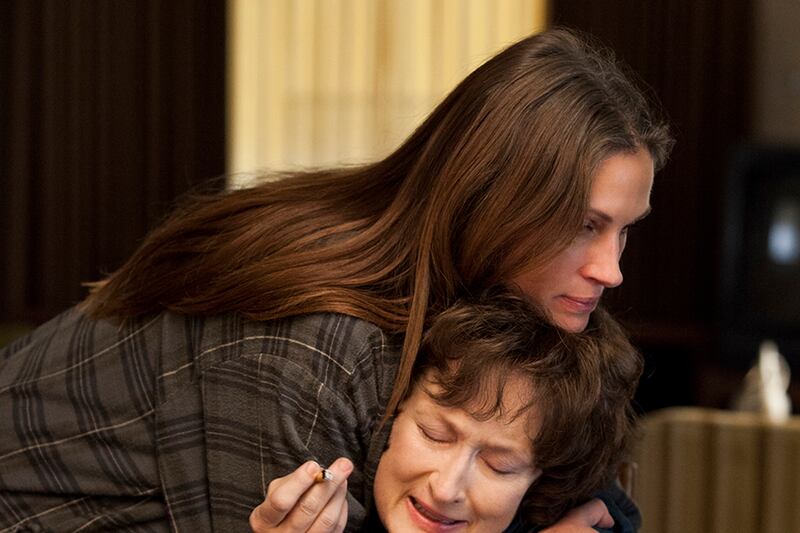
This was not a cosmetic transformation designed to generate headlines, but a deliberate artistic choice rooted in the demands of the story.
The film, based on Tracy Letts’ Pulitzer Prize–winning play, is an emotionally intense examination of grief, dysfunction, and long-suppressed family conflict.
To portray Barbara Weston authentically, Roberts understood that glamour would not only be unnecessary—it would be distracting. From the earliest days of filming, it became clear that Roberts was not interested in being seen as a movie star playing a role.
Instead, she aimed to inhabit the emotional reality of a woman under extraordinary pressure. Barbara Weston is a character defined by contradictions: strong yet deeply wounded, confrontational yet vulnerable, controlled on the surface but unraveling internally.
Capturing those layers required more than dialogue or dramatic moments; it required a complete physical and emotional commitment. On location in Oklahoma, where much of the film was shot, Roberts embraced a deliberately understated appearance.
Her wardrobe consisted largely of simple jeans, muted tops, and layered clothing that reflected the practical, unadorned life of her character.
Hair and makeup were kept minimal, allowing natural lines of stress, fatigue, and emotion to remain visible on screen. The result was a version of Julia Roberts that audiences were unaccustomed to seeing—one that felt grounded, real, and inseparable from the story being told. Continue reading…