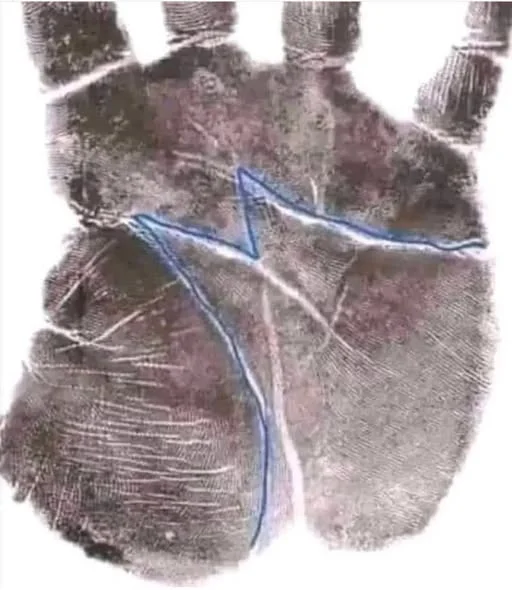
Palmistry traditionally identifies several major lines that appear on most human hands. These include the heart line, which runs across the upper palm; the head line, which crosses the middle of the palm; and the life line, which curves around the base of the thumb. Some people also have a fate line or sun line, which run vertically through the palm. In palm-reading traditions, these lines are interpreted symbolically rather than literally.

The “M” shape is said to appear when certain major lines intersect in a particular way. In palmistry lore, this usually involves a combination of the heart line, head line, life line, and sometimes the fate or sun line. When these lines intersect clearly, they can visually resemble the letter “M.” This configuration has been popularized online as being extremely rare, often claimed to occur in only one or two percent of the population. However, there is no scientific data to support precise statistics about how common or uncommon this pattern actually is.
In traditional palmistry interpretations, the “M” shape is often associated with strong intuition, leadership ability, and keen perception. Some palm readers suggest that individuals with this marking are particularly good at understanding people, making decisions, or navigating complex situations. These interpretations are symbolic and vary widely depending on the school of palmistry being followed.
It is important to note that palmistry does not claim to predict the future in a concrete or measurable way. Even within the tradition itself, practitioners often emphasize that palm lines reflect tendencies rather than destiny. They are said to suggest how a person might approach life, not what will definitively happen to them.
One term that is frequently confused in popular articles is the “Simian line.” In medical and anatomical terminology, a simian crease refers to a single transverse palmar crease, where the heart line and head line merge into one continuous line across the palm. This feature is present in a small percentage of the population and can occur in people with no health issues at all. It is also seen more frequently in certain genetic conditions, which is why medical professionals treat it as an anatomical variation rather than a mystical sign.
In palmistry folklore, however, the simian line is often reinterpreted symbolically and associated with intense focus or determination. This is a cultural interpretation, not a medical or psychological assessment.
Some modern articles claim that the “M” marking must appear on the non-dominant hand to be meaningful, suggesting that the non-dominant hand reflects innate traits while the dominant hand reflects learned behavior. Again, this distinction comes from palmistry tradition rather than scientific research. From a biological standpoint, there is no evidence that palm lines on one hand carry more psychological significance than those on the other. Continue reading…