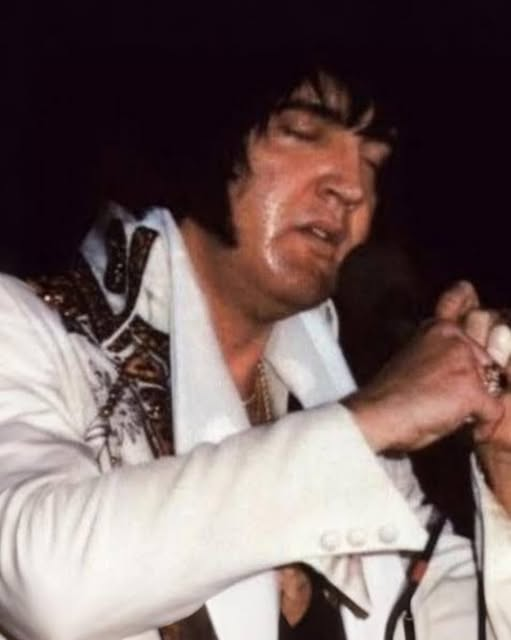
Elvis Presley’s Silent Battle — When Endurance Became His Fate
In the final years of his life, Elvis Presley was fighting a quiet and unseen war. It was not a battle against fame or fortune, but against his own body. The man who had changed music forever, who could still move millions with a single note, was slowly being betrayed by the blood in his veins.
In 2009, a DNA analysis revealed a painful truth that Elvis himself never had the chance to know. He suffered from four inherited medical conditions passed down through his mother’s family. Gladys Presley died at just forty-six years old, and none of her brothers lived beyond fifty. From the moment Elvis was born, his heart carried the same fragile destiny, ticking against a shortened clock long before the world ever heard his name.
Behind the rhinestones, the stage lights, and the deafening roar of crowds, Elvis lived with constant physical suffering. He battled hypertrophic cardiomyopathy, a dangerous condition that forced his heart to work harder than it ever should have. He endured glaucoma that threatened his vision, chronic migraines that crushed him with pain, and a genetic tendency toward obesity that placed relentless strain on his body.
His struggles went far deeper. Elvis suffered severe colon dysfunction, chronic liver stress, immune system weakness, and lifelong insomnia that began in childhood. Sleep never came easily to him, even when his body desperately needed rest. This was not the body of a man surrendering to excess, but the body of someone trying to survive one day at a time while still giving everything he had onstage.
Every medication Elvis took began as an attempt to heal. He used sedatives so he could sleep at night, stimulants so he could function during the day, opiates to dull the relentless migraines, and laxatives to counteract the damage caused by the rest. A cruel cycle took hold — one treatment leading to another, each prescribed with good intentions, each slowly creating new harm. Elvis was not searching for escape or pleasure. He was searching for balance, relief, and just enough strength to make it through another performance.
History has often painted Elvis as a drug abuser, but that portrayal ignores the reality of his suffering. Elvis did not take medication to feel high or to run from reality. He took it to endure. To keep singing. To keep standing under the lights when his body was failing him. To keep giving himself to the people who loved him.
He trusted medicine the same way he trusted God — sincerely, deeply, and without suspicion. Elvis believed that if something helped a little, perhaps more would help more. He placed his faith in his doctors, especially Dr. George Nichopoulos, who genuinely cared for him and correctly understood the illnesses he was battling. The tragedy was not neglect or indifference. It was compassion taken too far, with prescriptions multiplying in an attempt to ease pain that never truly went away.
By 1977, Elvis’s body could no longer carry the weight it had borne for decades. His heart, already weakened by genetics and worn down by relentless stress, finally failed. It was not the drugs that killed him, but the frailty written into his DNA — the same frailty that decades later would take his daughter, Lisa Marie Presley, in a hauntingly similar way.
Elvis did not die from excess. He died from endurance.
Even near the end, he continued to sing with remarkable depth and emotional power. His voice grew darker, richer, and more vulnerable, carrying a lifetime of pain, faith, and longing in every note. There was no emptiness in those performances — only a man reaching beyond his own suffering to connect with others, one last time.

The true tragedy of Elvis Presley is not that he died young. It is that he gave so much of himself simply trying to live for others. He carried the expectations of the world on a body that was never built to bear such a load. He pushed forward not for indulgence, but out of devotion — to his music, his faith, and his fans.
That is why, decades later, Elvis’s voice still carries such weight. It is the sound of a heart that beat too hard, too soon, and too beautifully for this world.
“If I Can Dream”: Elvis Presley’s Anthem of Hope and Defiance

When Elvis Presley stepped onto the stage of the NBC “’68 Comeback Special,” few could have predicted that he was about to deliver one of the most powerful performances of his life. Clad in an immaculate white suit and standing against a backdrop of glowing red letters spelling out
ELVIS, he closed the show with a song unlike anything he had ever recorded before—“If I Can Dream.”
Written by Walter Earl Brown in the wake of Dr. Martin Luther King Jr.’s assassination, the song became a vessel for sorrow, longing, and the desperate hope for a better world. For Elvis, whose childhood was shaped by poverty, inequality, and the deep racial divide of the American South, the lyrics struck a profound chord. The result was a performance that transcended entertainment and became a plea for unity, compassion, and justice.

A Song Born from Turbulence
1968 was one of the most turbulent years in American history. The Vietnam War was escalating, young people were marching in the streets, and the assassinations of Martin Luther King Jr. and Robert Kennedy left the nation grieving and disillusioned. Amid this unrest, Elvis—once the most electrifying young figure in music—was trapped in a cycle of formulaic Hollywood films and forgettable soundtrack songs.
When the producers of the NBC special approached Elvis with “If I Can Dream,” they feared Colonel Parker would reject it. It was too political, too direct, too emotional. But when Elvis first heard the demo, he reportedly said,
“I’m never going to sing another song I don’t believe in. This is the one.”
At that moment, the old Elvis—the hungry, passionate artist with something to say—came roaring back.

Lyrics Filled with Vision and Pain
“If I Can Dream” is built on simple but powerful imagery:
-
A dream of peace in a world filled with turmoil
-
Light breaking through darkness
-
A longing for understanding and unity
-
Hope that refuses to die
Lines like “We’re lost in a cloud / With too much rain” and “There’s a flame in the heart / That can burn away the pain” echo both the national mourning and Elvis’s own emotional struggles. He had watched the world change around him, even as he remained confined within the Hollywood machine. This song allowed him to speak—openly, earnestly, passionately.
Most remarkably, the lyrics echo Dr. King. Not in a way that imitates but in a way that honors. Elvis, who deeply admired King, poured every ounce of sincerity into those lines. His performance carries grief for what was lost and a prayer for what could still be saved.

The Recording That Stunned Everyone
Elvis recorded the song on June 23, 1968. The studio was dimly lit, and the atmosphere felt almost like a vigil. Backed by a full orchestra, Elvis delivered take after take—each more emotional, more urgent, more explosive.
The musicians were stunned. The producers were stunned. Even Colonel Parker, who initially opposed the song, was left speechless.
Elvis wasn’t just singing—he was pleading. His voice cracked, soared, and trembled with conviction. Those who watched said it was the first time in years they saw the same fire that defined his early Sun Records sessions.