ADVERTISEMENT
Before we get to Washington, let’s set the stage with a look at the decade before he was born. Hegseth’s religious claim simply doesn’t pass the smell test in the context of people who keep trying to claim the mantle of the Founding Fathers. In the 1720s in Boston, a smallpox epidemic led to a widespread debate over variolation—an inoculation technique that is a precursor to today’s vaccines, introducing small doses of live smallpox to people so that they might have a mild infection and then develop protective immunity. The debate played in press and pulpit, because variolation could indeed cause fatal cases of smallpox.2
That’s right. Cotton Mather—Puritan luminary, proponent of hunting witches—was a big believer in inoculation. Mather inoculated his own son after learning about the procedure from the Philosophical Transactions of the Royal Society and the testimony of his enslaved servant Onesimus, who had been inoculated in West Africa before he was kidnapped. With Mather’s support, Dr. Zabdiel Boylston experimented on Mather’s son, Mather’s enslaved servant Jack, and Jack’s son, and when none of them developed full cases of smallpox, began continuing with other people. There was intense pushback—a bomb was thrown into Cotton Mather’s house on November 14, 1721, because of his advocacy—but the campaign moved forward.
A half-century later, smallpox was enough of a problem—and inoculation had become enough of a proven technique—that this was not just a matter for individual cities and individual clergy to debate but a matter of urgency for the war for independence. Smallpox broke out in the Quebec campaign, ravaging the Continental Army in 1775 and 1776. As John Adams3 wrote to his wife, Abigail, in June 1776,
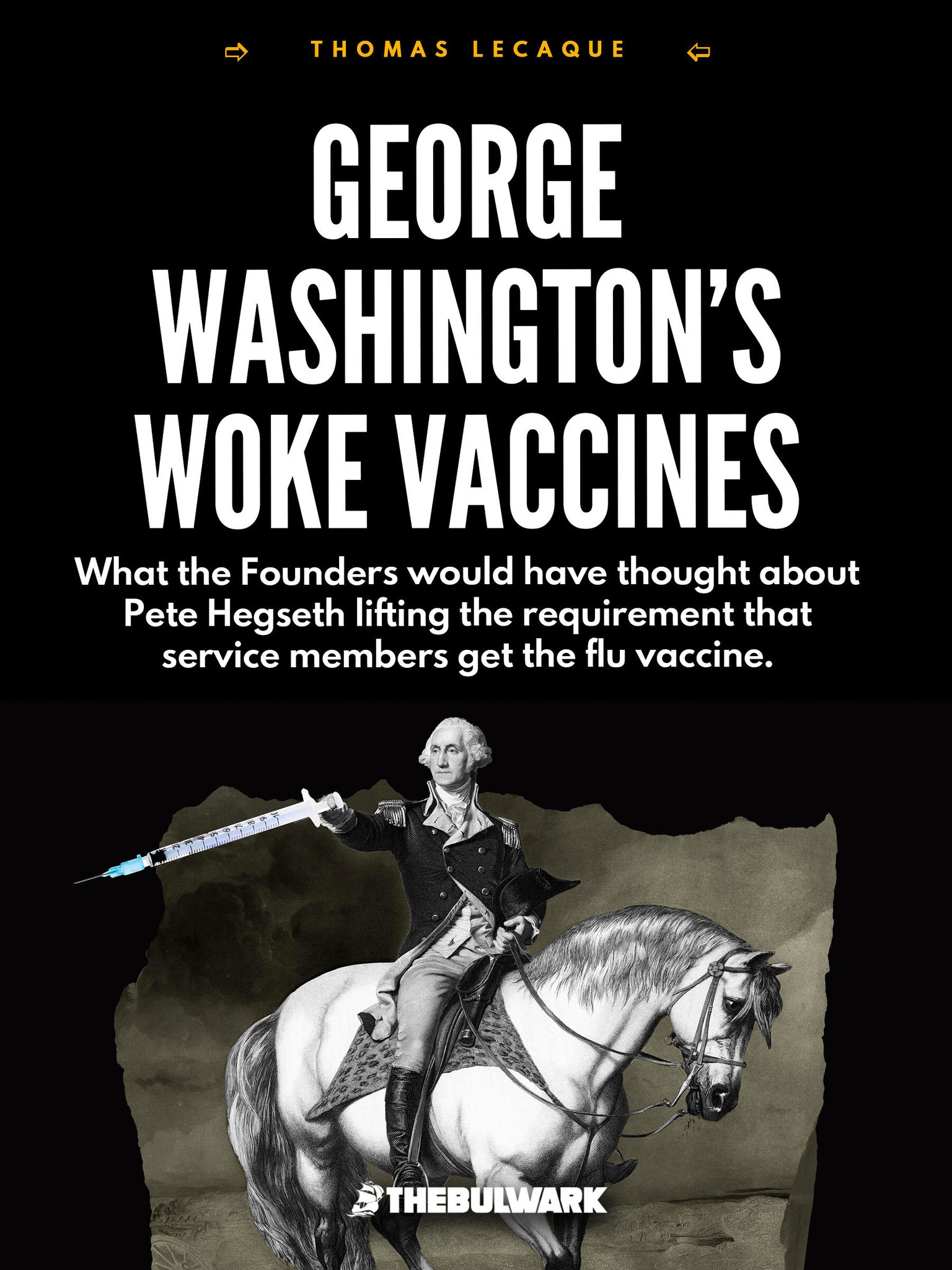
Smallpox was a fundamental threat. And while quarantines were an important part of the solution, quarantines during an active military campaign were far from ideal. So in February 1777, George Washington, the commander-in-chief of the Continental Army, wrote a letter to William Shippen, Jr., director general of the hospitals for the army:
Finding the Small pox to be spreading much and fearing that no precaution can prevent it from running through the whole of our Army, I have determined that the troops shall be inoculated. This Expedient may be attended with some inconveniences and some disadvantages, but yet I trust in its consequences will have the most happy effects. Necessity not only authorizes but seems to require the measure, for should the disorder infect the Army in the natural way and rage with its usual virulence we should have more to dread from it than from the Sword of the Enemy.
Now skip ahead a generation to when smallpox vaccination came to America. (The word “vaccination” comes from the Latin for cow, since the English physician Edward Jenner proved in the 1790s that intentionally infecting someone with cowpox could confer immunity to smallpox.) The Founding Fathers welcomed vaccination. On Christmas Day in 1800, Thomas Jefferson wrote to Benjamin Waterhouse, the physician who brought the technique to America, that “every friend of humanity must look with pleasure on this discovery.”Continue reading…
